



SIGNAL
Every audio system is built around the movement of signal. From instrument to amplifier, from console to monitor, that signal carries frequency, phase information, harmonic content, and dynamic range. How consistently it travels — and how well it resists interference — directly shapes tone, feel, and performance integrity.
Asterope’s geometric conductor designs, material selections, and precision assembly techniques are developed with signal behavior in mind. Conductor layout, shielding topology, dielectric materials, and copper strand count all influence impedance stability, frequency response consistency, and overall signal-to-noise ratio (SNR). When these variables are balanced correctly, phase coherence is maintained, EMI and RFI are mitigated, and harmonic detail is preserved across both studio monitoring environments and high-demand live performance systems.
Signal is not abstract. It is measurable, physical energy moving through a conductor. The goal is simple: support stable signal path integrity so that dynamic range, transient accuracy, and tonal balance remain intact under real-world conditions — whether in controlled recording spaces or complex touring environments.
“Asterope is amazing technology beyond anything you can possibly imagine. I plugged it in and it was a jaw dropping experience. This is one of the most impressive technologies in the audio industry and one of the most critical components you can add to your rig. Asterope is not just a cable – it is far more. Dollar for dollar there’s not a single piece of gear that improves and enhances the sound of any musical instrument or component more than Asterope.”
STRUCTURES
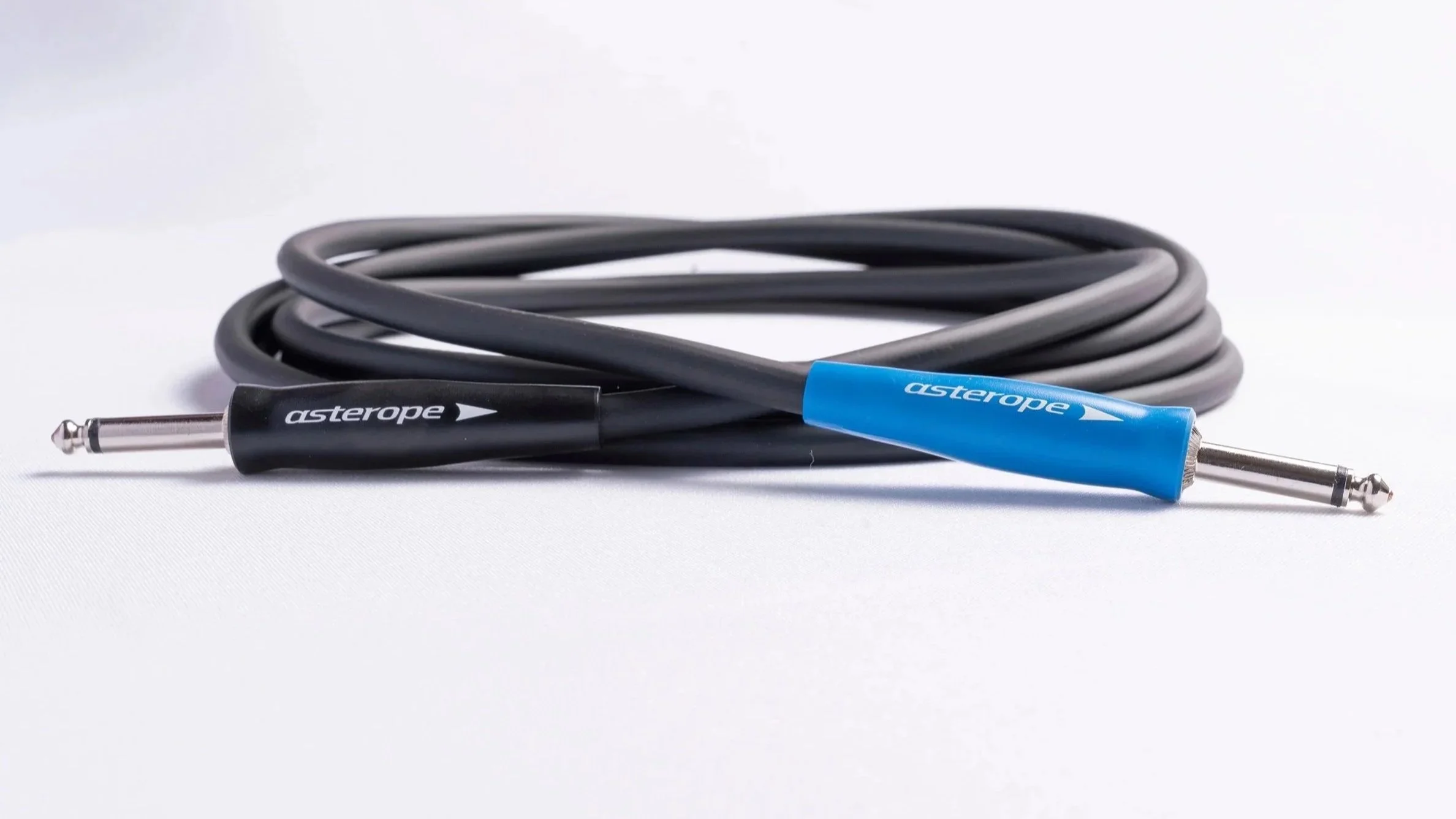
Material selection directly shapes both electrical performance and long-term reliability. Asterope builds with a two-conductor, high-stranded, premium oxygen-controlled copper design engineered for stable conductivity, consistent resistance per foot, and reliable current handling across varied signal paths. Elevated copper strand counts and disciplined geometric layout support flexibility while maintaining mechanical resilience under repeated stress in studio, touring, and installation environments.
Each assembly incorporates a 95% cross-braided shielding topology to promote effective EMI and RFI mitigation, supporting a stable signal-to-noise ratio (SNR) and predictable impedance behavior under real-world conditions. Advanced dielectric insulation materials are selected to help regulate capacitance characteristics, preserve frequency response consistency, and support accurate transient response over both short and extended cable runs.
Precision assembly techniques and strain-relief strategies are implemented to protect conductor integrity under flex, load, and vibration. The combined effect of disciplined material selection, controlled geometry, and consistent build methods is measurable electrical stability paired with long-term physical endurance — ensuring signal integrity remains dependable across demanding recording, rehearsal, and live performance systems.
“As a recording engineer, I’m trying to get as much information out of each instrument as I possibly can. Asterope preserves the integrity of the signal at its most vulnerable and critical link between source and amplification. Asterope simply gives you more information and more sonic data. This technology has to be experienced. It is truly remarkable!”
SONICS
While electrical parameters are measurable, their effects are ultimately perceived. Human hearing is highly sensitive to changes in transient timing, phase relationships, and harmonic structure. Variations in capacitance, impedance behavior, and shielding effectiveness can influence the way high-frequency openness, midrange articulation, and low-frequency control are experienced.
Psychoacoustic perception is closely tied to phase coherence and harmonic content preservation. Small deviations in frequency response consistency or dynamic range can affect spatial imaging, detail retrieval, and perceived clarity within a mix.
Understanding both the measurable science and the perceptual outcome allows for informed decisions about signal chain optimization — balancing objective electrical performance with the subjective experience of tone.
“I got turned on to Asterope years ago and have been using them ever since. Asterope cables are warmer, thicker, better… pick the adjective. I’m always looking for bigger, richer tone, and I was immediately able to hear it with Asterope. I didn’t have to search for it. It was quick and easy, so I started using them on all my gigs and sessions. They sound amazing and are built to last.”
Frequently Asked Questions:
-
When you consider the time you’ve invested in learning your instrument, the care you’ve put into shaping your sound, and the money you’ve spent building a rig you trust, the question answers itself. Your cable is the final link in that chain, carrying every nuance of your playing from source to destination. Many professional musicians, producers, and engineers choose to upgrade this link not out of hype, but out of respect for their craft and the music they create. Investing in a high-quality cable is less about chasing perfection and more about honoring the work you’ve already done—allowing your sound to arrive intact, expressive, and true to you.
-
Asterope cables are built around the demands of professional performance, where consistency, clarity, and trust are non-negotiable. Every design choice, from conductor geometry and quality of copper, to specific dielectric materials to mechanical stability and termination, all serve the same purpose: preserving phase, reducing noise, and allowing the signal to move freely and predictably. Hand-built in the United States using carefully selected materials and disciplined processes, Asterope cables deliver sonic performance and mechanical stability. For professionals who must be fully present every time they play, reliable gear isn’t a luxury, it’s the foundation of their sound. Asterope exists to meet that standard.
-
Yes… and you’ll feel it as well. Asterope cables are engineered for exceptional phase coherence, clarity, and bandwidth, allowing more of the original signal to arrive intact. The result is an immediate sense of openness, faster transients, richer harmonic detail, and improved spatial definition, whether you’re playing an instrument, shaping a mix, or listening critically in the control room. Engineers and producers often notice the difference just as quickly as musicians, because timing, balance, and harmonic relationships become easier to hear and place. Many people are surprised by how dramatic the change is, which is why we call it the Wow factor. It’s not subtle, it’s the result of reduced loss and better alignment throughout the signal path. Asterope delivers more between the gear and the ear.
-
Beyond the visual distinction—the Studio series in burgundy and the Stage series in black—the primary difference lies in connector plating and how it subtly shapes signal behavior. The Pro Studio cables use gold-plated connectors, which tend to preserve a slightly more open, extended, and bell-like presentation, favoring detail, air, and harmonic nuance in critical listening environments. The Pro Stage cables use nickel-plated connectors, which are often perceived as a bit more focused and percussive, with a tighter, punchier response that translates well in high-gain or high-energy live settings. For ultra-high-resolution applications where maximum openness and finesse are desired, the Studio series is typically the better choice. In environments where durability, consistency, and a touch of natural high-frequency restraint are beneficial, the Stage series often feels more controlled and confident.
-
Funny you should ask! Yes there are. Explore signal and sound, where inspiration, phase, transients, harmonics, spectral balance, and human perception, are all visually communicated to help describe core aspects of creating and listening. These images reflect the physical behavior of frequency and signal in a way that honors both the precision of science and the human experience. VIEW HERE >
-
In professional audio environments, everything begins with capture and ends with translation. Asterope’s Pro Audio cables are designed to preserve timing, balance, and phase accuracy across the entire signal chain, from microphones and converters to monitors and speakers. Our XLR-to-XLR and TRS-to-XLR cables are built to maintain consistent impedance and low noise, making them ideal for critical microphone paths as well as converter-to-monitor connections where precision matters most. Seasoned engineers and producers describe an immediate improvement: clearer imaging, more stable center focus, and a sense that the entire room “locks in” as phase relationships across channels become easier to hear and trust.
For monitoring and speaker connections, conductor gauge becomes especially important. Asterope’s flagship 20 AWG designs perform exceptionally well with nearfield monitors and smaller drivers up to approximately five or six inches, offering speed, clarity, and control. For larger monitors and higher current demands, our Pro-X 16 AWG solutions are recommended, providing improved current delivery, tighter low-frequency control, and greater headroom without sacrificing detail. The result is a monitoring system that feels more coherent, more balanced, and more revealing, allowing creators to hear and feel their decisions with greater confidence and accuracy.
-
Asterope cables are designed, sourced, built, and assembled in the United States. To remove all barriers from trying an Asterope, every cable is backed by a 30-day money-back guarantee and a limited lifetime warranty. We build our products with intention, precision, and care—so you can rely on them every time you plug in. Because your music, your confidence, and your trust matter.
-
Registering your Asterope cable is quick and simple. Just visit our Product Registration page and enter a few basic details about your cable and where it was purchased. Registration helps us support you with product information, cable care, warranty assistance, and future updates.
-
You can be playing through your own Asterope cable as soon as you order one! All cables ship within 2-3 business days, and often sooner. If you’re ready to upgrade your groove, we’re ready to help get you there. BUY NOW »
-
Absolutely. You can email any questions to info@asterope.com, and someone from our team will get back to you as soon as possible. We’re always happy to talk through your rig, your room, or your project to help you choose the best solutions for your needs.Item description
-
Yes. In addition to our musical instrument and professional audio cables, Asterope also provides commercial and industrial-grade cable solutions for large-scale installation and infrastructure projects. These American-made products are engineered for durability, performance consistency, and long-term reliability in demanding environments.
For full specifications and available product lines, please see our Industrial Catalog >
Updated Q2 - 2026